
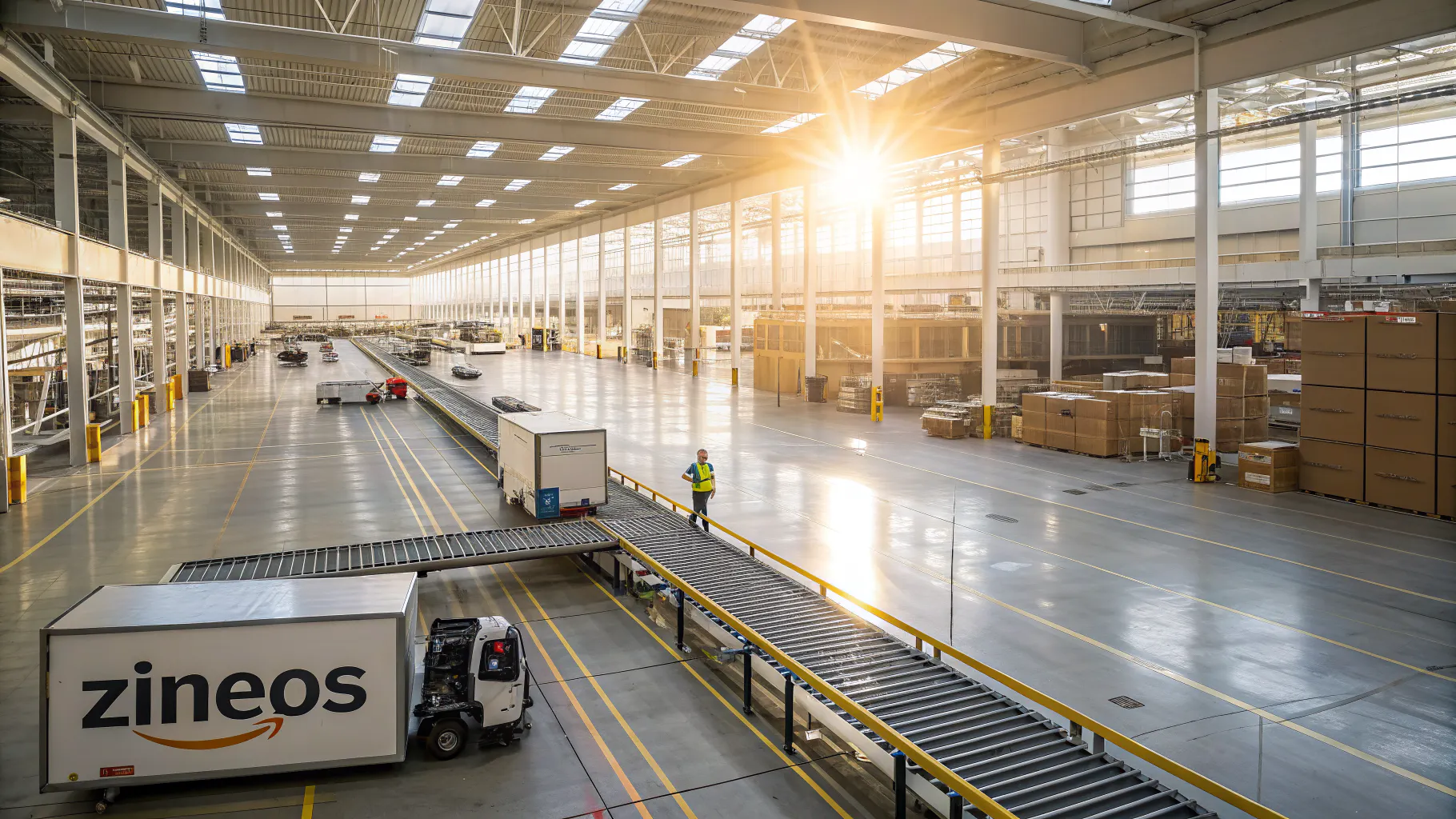
Agentic AI Shopping Has Arrived: Why Fulfillment Is Now E-Commerce's Only Real Differentiator in 2026
Agentic AI Shopping Has Arrived: Why Fulfillment Is Now E-Commerce's Only Real Differentiator in 2026
Something changed in the first half of 2026 that most e-commerce teams are still catching up to. Shoppers are no longer the only ones browsing product pages, comparing prices, and clicking buy. AI agents are doing it for them, and doing it at a scale that front end marketing teams were never built to compete with. Salesforce, which tracks commerce traffic across a large share of the retailers running on its platform, found that traffic referred from AI chat assistants grew between 150 and 428 percent year over year in every quarter it measured in 2026, while overall site traffic across the same retailers grew only in the single to low double digits.
That gap is not a rounding error. It is a structural shift in who the customer actually is at the moment of discovery. When a shopping agent compares five retailers on price, delivery speed, and return policy in under a second, a discount code and a homepage hero banner stop being competitive advantages. An algorithm does not notice a banner. It reads a delivery promise, a stock feed, and a return policy, then makes a decision a human shopper never sees being made on their behalf.
From front end optimization to operational backbone
For a decade, e-commerce growth was mostly a front end problem. Better product photography, faster page loads, smarter retargeting, a checkout with fewer fields. Every one of those levers assumed a human was doing the browsing and could be nudged, delighted, or mildly annoyed into converting anyway. Agentic commerce removes the nudge. An AI agent does not get delighted by a hero image and it does not abandon a cart because it changed its mind while scrolling Instagram. It executes a decision based on structured data, price, stated delivery date, live stock status, and return terms, then it buys, and it moves on.
That is why the center of gravity in e-commerce is moving away from the parts of the business a customer used to see first and toward the parts a customer, human or artificial, used to see last. Order management, carrier selection, warehouse throughput, and post purchase communication used to be back office plumbing. In an agentic buying environment they become the product, because they are the only part of the transaction an algorithm can actually verify before it commits a customer's money.
What an AI shopping agent can verify, and what it cannot fake
A marketing claim is easy to write and hard for software to check. A delivery promise is different, because it either holds up against a carrier's actual scan data or it does not, and an agent built to compare retailers will increasingly cross reference the two. The same is true for stock accuracy, return windows, and how quickly a retailer resolves a shipment exception. None of that lives on a landing page. All of it lives inside whatever system actually manages the shipment once an order is placed, which for most mid size e-commerce brands today is a patchwork of a shipping tool, a handful of spreadsheets, and a support inbox absorbing the difference between what checkout promised and what the warehouse could actually do.
This is the part of the shift that gets lost in the more headline friendly conversation about chatbots and AI assistants. Agentic commerce does not reward the retailer with the cleverest AI powered storefront. It rewards the retailer whose fulfillment operation was already accurate, fast, and consistent enough that an agent verifying its claims finds nothing to flag. Fulfillment stops being a cost center to control and becomes the evidence an algorithm checks before it trusts a brand with a purchase.
Three ways agentic commerce exposes a fragile fulfillment stack
The delivery promise gets tested before the sale, not after
A human shopper who receives a vague delivery estimate might still buy out of habit or brand loyalty. A purchasing agent optimizing for a stated outcome, like the fastest reliable delivery under a given price ceiling, will simply route the sale to whichever retailer's data looks more precise and more accurate historically. Retailers whose shipping software cannot generate a confident, carrier verified delivery date at the SKU and postcode level are invisible to that comparison, not because the agent is biased against them, but because vague data does not clear the bar an agent is built to filter on.
Post purchase experience becomes an input signal, not a support cost line
Shopping agents that get reused, the kind retailers actually want to be discovered by, learn from outcomes. An agent that routed a purchase to a retailer whose parcel arrived late, arrived damaged, or generated three separate WISMO support tickets is, in effect, training data against that retailer for the next comparison. Post purchase experience used to be measured mainly in support ticket volume and customer satisfaction scores that a marketing team rarely saw. In an agentic buying loop, it becomes a variable that quietly feeds the next round of recommendations, which is a very different kind of pressure on a warehouse floor than a quarterly NPS review.
Returns policy clarity becomes a purchase filter, not fine print
Return terms sit in a footer link that most human shoppers never open before buying. An agent comparing purchase options for a customer who explicitly cares about return flexibility will open it every time, because that is precisely the kind of structured comparison an agent is good at and a human rarely bothers with. Retailers whose return policy is inconsistent across channels, or whose return window depends on which carrier delivered the parcel, are handing an agent a data quality problem it will resolve by simply choosing a competitor whose policy is easier to verify.
A founder's checklist for the day an agent, not a person, places the order
- Can your shipping system generate a delivery date estimate that is accurate at the postcode level, not just a national average, and can it prove that accuracy against real carrier scan data.
- Is your stock feed synced closely enough to checkout that an agent comparing availability right now is not acting on data that was already wrong ten minutes ago.
- If your primary carrier has an outage, does a customer facing delivery promise change automatically, or does it keep quoting a date your operations team already knows it cannot hit.
- Is your return policy identical across every channel and every carrier, or does it quietly depend on which warehouse fulfilled the order.
- Do shipment exceptions, a missed pickup, a damaged parcel, a failed delivery attempt, get resolved and communicated automatically, or do they wait for a support ticket an agent evaluating your brand will never see resolved in time.
An audit you can run this week
- Pull last month's promised delivery dates against actual carrier delivered dates and calculate your real accuracy rate at the postcode level, not the national one, since that is the granularity an agent will eventually compare.
- Check how many minutes of lag exist between a warehouse stock change and that same change reflecting in your live product feed, since that gap is exactly where an agent finds a promise it cannot verify.
- Count how many of last month's shipment exceptions were resolved automatically versus how many required a customer to open a support ticket first, because that ratio is what post purchase experience actually measures.
- Read your own return policy the way a comparison agent would, looking specifically for any clause that depends on carrier, warehouse, or order channel, since inconsistency there is a data quality flag before it is a customer complaint.
None of these checks require new software to run once. They require pulling data most e-commerce teams already have scattered across a shipping tool, a warehouse system, and a support inbox, and comparing it side by side for the first time, the same way an outside algorithm eventually will.
How Zineps closes that gap
This is exactly the layer we built Zineps to own. As the Operating System for Shipments, Zineps unifies carrier selection, delivery date accuracy, and shipment exception handling into one system instead of leaving each piece to a different tool that only talks to the others through a support ticket. We have written before about why e-commerce brands are outgrowing standalone shipping software faster than most roadmaps account for, and about how a unified shipping stack removes the hidden cost of a fragmented fulfillment operation. Agentic commerce does not create a new problem so much as it puts a very fast, very literal auditor on top of a problem logistics teams have managed by hand for years.
The same logic applies to post purchase support. We have also written about why WISMO tickets, the where is my order messages that quietly drain support teams, are really a symptom of shipment visibility gaps rather than a staffing problem. Every one of those tickets is a data point an AI agent could eventually see, directly or indirectly, through review patterns, repeat purchase behavior, and public delivery feedback. Brands that close that visibility gap now are not just cutting support costs, they are cleaning up the exact signal agentic commerce will start reading.
Brands running shipping through Zineps do not need a separate AI strategy to prepare for agentic buying. They already have accurate carrier data, automated exception handling, and a single source of truth for delivery promises, which is precisely the operational foundation an agent, or a very demanding human, checks before it decides a brand can be trusted with an order.
The bottom line
E-commerce spent the last decade competing on the parts of the business a customer saw first. Agentic commerce is quietly rewriting the test to focus on the parts a customer, or the software shopping on their behalf, checks before it ever reaches the homepage: whether the delivery date is real, whether the stock is accurate, and whether a shipment problem gets fixed without a support ticket. None of that is solved by a better chatbot. It is solved by a fulfillment operation accurate and consistent enough that an algorithm auditing your brand in half a second finds nothing worth flagging. That is the operating system e-commerce needs for 2026, and it is the one we built Zineps to be.