
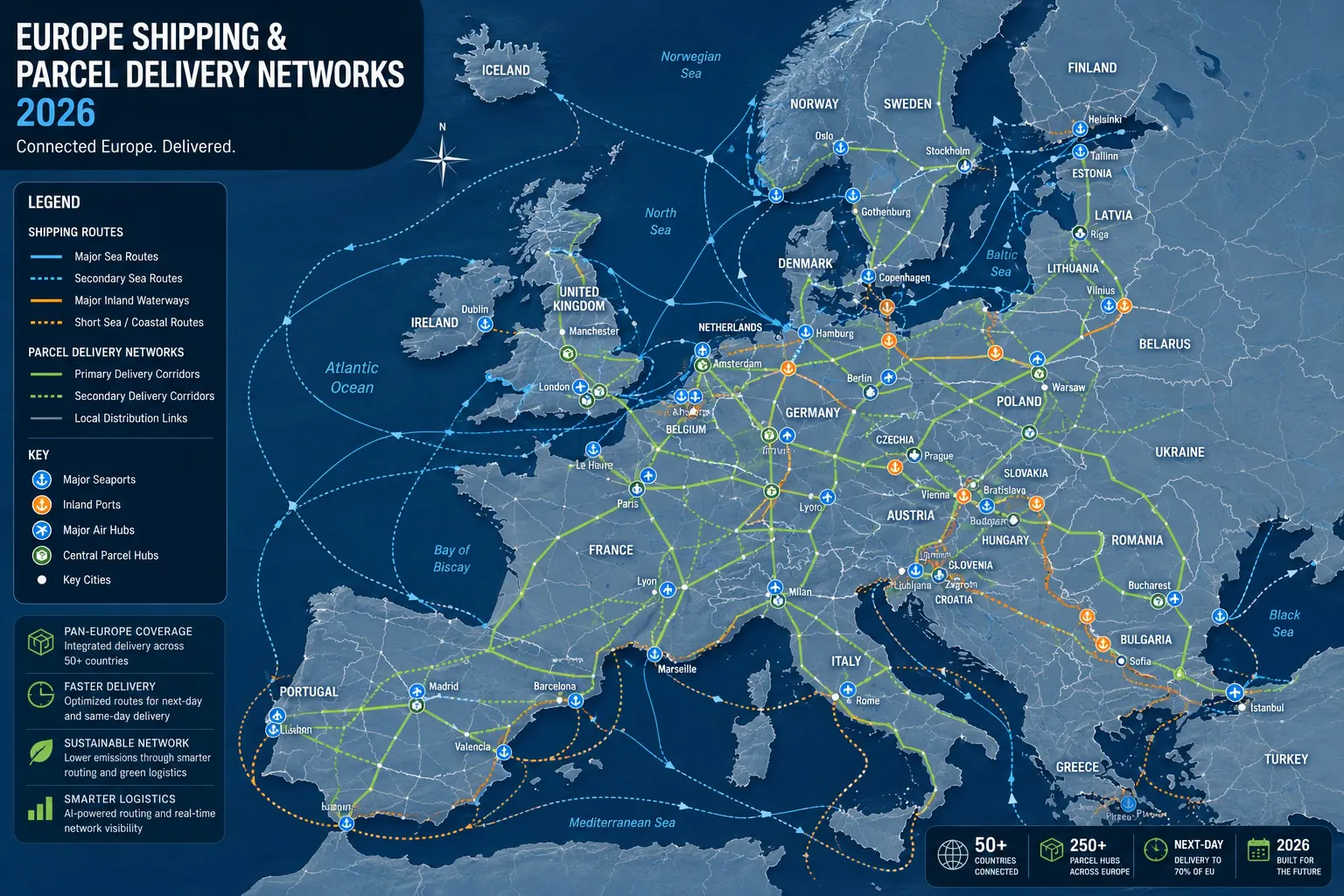
How to Build a Country-Specific Shipping Strategy for European Markets in 2026
Consumer delivery preferences across Europe are not uniform. They differ significantly by market, driven by infrastructure maturity, cultural expectations, regulatory environment, and the competitive benchmarks set by dominant local retailers. A single shipping strategy applied across Germany, the Netherlands, France, Spain, and Poland simultaneously is not a European strategy. It is a compromise that underperforms in every market.
The latest consumer data from 8,000 European shoppers across eight markets confirms this. Preferences for delivery speed, out-of-home options, free shipping thresholds, and return expectations vary substantially by country. And the retailers that adapt their logistics to each market outperform those that do not.
This is your operational guide to building a shipping strategy that works market by market.
Why a One-Size-Fits-All Approach Fails in Europe
Europe is often described as a single market. In legal terms, there is truth to that. In logistics terms, it is a collection of distinct consumer cultures with different expectations, different carrier ecosystems, and different infrastructure densities.
In the Nordics, 77% of consumers say the ability to choose a pickup location is the most important factor when deciding where to shop. In Germany, e-commerce return rates approach 44%, driven by consumer protection laws that make free and easy returns a cultural norm. In the Netherlands, 95% of the population shops online, creating one of the most competitive delivery environments in Europe where next-day and same-day delivery are standard. In Spain, 75% of e-commerce transactions happen on mobile, which shapes how checkout options and shipping choices must be presented.
A German consumer who cannot return for free without friction will not buy from you again. A Norwegian consumer who cannot see a nearby pickup point at checkout is likely to abandon the cart. A Dutch consumer who sees a 3 to 5 day delivery estimate when the domestic standard is next-day is receiving a clear signal that your operations are not optimized for their market.
These are not edge cases. They are the baseline expectations that shape purchase decisions for tens of millions of European consumers.
Germany: High Volume, High Return Rates, High Expectations
Germany is the largest e-commerce market in continental Europe and sets a demanding benchmark for logistics operations. Return rates in fashion approach 44 to 50%, driven by what is known locally as Kauf auf Probe, meaning purchase on trial. German consumers routinely order multiple sizes or versions, keep what fits, and return the rest. This is not an anomaly. It is a cultural shopping norm.
For any retailer operating in Germany, the returns process is not a cost to minimize. It is a customer acquisition and retention tool. 92% of consumers say they will buy again if returns were easy, and German consumers use the returns policy as a pre-purchase trust signal more than almost any other European market.
Operational Requirements for Germany
- Free return labels or in-store drop-off options via DHL, Hermes, or DPD
- Fast refund processing: 85% of consumers expect a refund within one week
- Clear, simple return instructions provided in German
- Return tracking included in the post-purchase communication flow
The Netherlands: Speed-First, Sustainability-Second
The Netherlands has one of the highest e-commerce penetration rates in the world, with close to 95% of the population buying online. The Dutch consumer benchmark has been set by bol.com and Coolblue, both of which offer next-day and often same-day delivery as standard. Any retailer entering or scaling in the Netherlands should treat next-day delivery as the floor, not a premium.
What makes the Dutch market particularly interesting is the combination of high delivery speed expectations with growing sustainability consciousness. Delivery notifications, packaging choice, and carbon offset options are all conversion factors for a meaningful share of Dutch shoppers.
Operational Requirements for the Netherlands
- Next-day delivery as a standard option, not a premium upsell
- PostNL integration is non-negotiable for domestic residential reach
- DHL and DPD for supplementary carrier network coverage
- Bicycle courier and same-day services in Amsterdam, Rotterdam, and The Hague are increasingly expected
- Dutch-language tracking pages and proactive delivery notifications
The bol.com fulfillment network recently opened to third-party sellers. This changes the competitive landscape for logistics providers serving Dutch retailers. Brands that cannot match bol's delivery benchmarks will face increasing pressure on conversion rates in the Netherlands.
France: Pickup Points Are Mainstream, Mobile-First Is Reality
France has one of the most developed pickup point networks in Europe. Mondial Relay, Colissimo, and DPD all operate extensive PUDO networks across the country. French consumers are comfortable with pickup delivery as a primary option, not an alternative. Nearly 36% of European consumers prefer out-of-home delivery, and France sits above that average.
France is also a mobile-first shopping market. Checkout experiences and shipping option presentations that are not optimized for mobile will see higher abandonment rates than in markets where desktop still dominates.
Operational Requirements for France
- Mondial Relay or Chronopost PUDO integration for pickup point coverage
- Mobile-optimized checkout shipping option presentation
- French-language tracking and post-purchase notification flows
- Clear import documentation for cross-border shipments entering from outside the EU
Belgium: The Crossroads of European Logistics
Belgium's geographic position makes it one of the most logistics-dense countries in Europe. Liege is home to a major air cargo hub. Brussels sits at the center of European road freight corridors. For cross-border shippers serving multiple European markets, Belgium is often a natural distribution hub.
Belgian consumers have high expectations for both home delivery and pickup point access. bpost is the dominant domestic carrier, with broad residential coverage. DPD and bpack both have extensive PUDO networks across Belgium, making this a market where both delivery modes need to be well-served.
Operational Requirements for Belgium
- Dual-language capability in French and Dutch for tracking pages and notifications
- bpost integration for domestic residential delivery coverage
- PUDO options via DPD or bpack for out-of-home pickup
- Cross-border carrier connections given Belgium's hub position in European logistics corridors
Poland: Parcel Lockers Are the Standard
Poland has undergone one of the fastest logistics infrastructure transformations in Europe over the past decade, driven almost entirely by InPost's parcel locker network. InPost now operates over 35,000 automated parcel lockers across Poland, and the Polish consumer has been conditioned to expect locker delivery as the default option.
For retailers entering Poland, InPost integration is not optional. Consumers who cannot select a nearby locker at checkout will often choose a competitor who offers it. Home delivery exists in Poland, but for a significant share of the market, the locker is simply the preferred way to receive packages.
Operational Requirements for Poland
- InPost integration as the primary delivery option for Polish consumers
- Polish-language customer communications across every post-purchase touchpoint
- Competitive shipping costs: Polish consumers are particularly price-sensitive on delivery fees
- Reverse logistics through the InPost locker network for seamless returns
The success of InPost in Poland is already influencing Western European markets. InPost has expanded into the UK, France, and Italy. The locker delivery model pioneered in Poland is becoming the template for European out-of-home delivery growth, and brands with existing InPost integration benefit from that network expansion automatically.
Spain and Southern Europe: Mobile-First, Flexibility-Second
Spain, Italy, and the broader Southern European market share common characteristics. Mobile commerce is dominant: 75% of Spanish e-commerce purchases happen on mobile. Delivery expectations are slightly more flexible than in Northern Europe, with 2 to 3 day delivery more widely accepted. But this is changing as local marketplaces and major retailers raise the bar on delivery speed.
Operational Requirements for Spain and Italy
- Correos in Spain and Poste Italiane in Italy for domestic reach, especially in rural areas
- GLS and DHL for faster and more reliable urban delivery performance
- Mobile-optimized shipping selection at checkout with minimal friction
- Language-native notifications and tracking in Spanish or Italian respectively
What Running Country-Specific Strategies Actually Requires
Running country-specific shipping strategies simultaneously requires something most retailers do not currently have: the operational infrastructure to make different decisions by market, in real time, at scale. Four capabilities need to work together.
Multi-carrier routing by destination. The ability to route a German shipment via DHL, a Polish shipment via InPost, and a French shipment via Mondial Relay automatically, based on the destination, without manual intervention for every order.
Country-specific rate logic. Different pricing for domestic delivery by country, with dynamic selection of the cheapest carrier that meets the delivery promise for each destination, updated in real time as carrier rates and performance change.
Localized post-purchase communication. Language-native tracking pages and notification flows that match the consumer's country of residence, not a single generic carrier page that loses the brand experience the moment the parcel leaves the warehouse.
Returns configuration by market. Different return policies, return carrier options, and refund timelines configured per country, automatically applied based on where the consumer is located. A German consumer gets a free DHL return label. A Polish consumer gets an InPost locker return option.
This is not a carrier selection problem. Carriers are widely available across all European markets. This is an integration and orchestration problem. The software layer that connects your order management, your warehouse system, and your carrier portfolio needs to make these market-specific decisions automatically, every time, for every shipment.
Read more about European e-commerce market data at E-commerce Germany News.
How Zineps Enables Country-Specific Shipping Operations
Zineps operates as the Operating System for Shipments. It connects shippers, carriers, fulfillment providers, and logistics partners into a single unified environment where market-specific routing logic can be configured, monitored, and optimized from one place.
For e-commerce brands scaling across European markets, Zineps provides carrier integrations across all major European networks, including PostNL, DHL, DPD, InPost, Mondial Relay, bpost, GLS, and more. Rule-based shipping logic automatically routes each shipment based on destination country, carrier performance, cost, and delivery promise. Localized tracking experiences in multiple languages, branded to your store, replace generic carrier tracking pages. Returns management is configured by market, with carrier-specific return label generation applied automatically at the moment of purchase.
The consumer data from 2026 confirms that European shoppers are not a monolith. They have distinct, market-specific expectations for delivery speed, pickup options, return policies, and post-purchase communication. The retailers that meet those expectations in each market will outconvert and outretain those that treat Europe as a single operational zone.
Building a country-specific shipping strategy is not a luxury for large enterprises. It is the operational baseline for any brand serious about European e-commerce in 2026. The businesses that build this infrastructure now will not just meet today's expectations. They will be positioned to adapt as those expectations continue to rise.